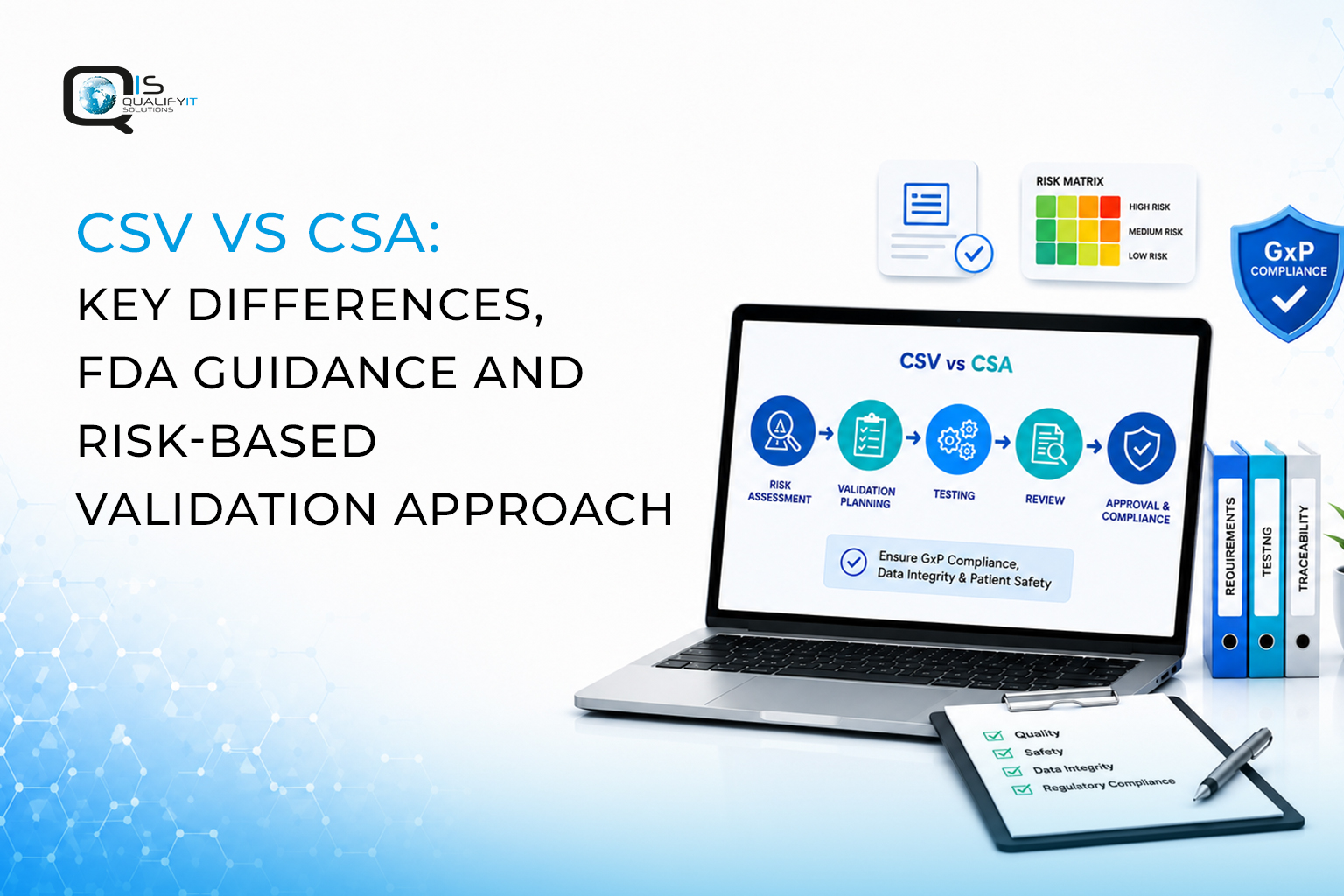
CSV vs CSA: Key Differences, FDA Guidance and Risk-Based Validation Approach
Most regulated organizations already know Computer System Validation well. It has been the standard way to show that a computerized system works as intended, supported by documented evidence.
But the way software gets built and delivered has changed. SaaS applications, cloud platforms, automation, and frequent releases have made the old validation playbook feel heavier than it needs to be for many systems. That gap is exactly what computer software assurance was designed to close: a risk-based approach built around critical thinking, intended use, and evidence that actually matters.
In this article, we will unpack the difference between CSV and CSA, sometimes framed as CSV vs. CSA or the difference between CSV and CSA, what changed with FDA CSA, whether CSA replaces CSV validation, and how you can decide the right level of testing for your systems.
If you want the full walkthrough of the traditional approach first, our Computer System Validation guide covers that in depth. For the broader concept of oversight beyond a single software function, the term computer system assurance is also sometimes used, though the FDA’s defined term remains computer software assurance.
What Is Computer System Validation?
Computer System Validation, or CSV, is the process of documenting evidence that a computerised system consistently performs as intended. It exists to protect patient safety, product quality and data integrity while satisfying regulatory expectations.
At its core, CSV validation confirms fitness for intended use for GxP computerized systems and helps organizations maintain that validated state over the system’s life. This is the foundation behind our software validation services, where we help teams build and maintain that validated state across their systems.
A traditional validation lifecycle generally follows this path:
- User Requirements Specification (URS)
- Risk Assessment
- Functional and Design Specifications
- Installation Qualification (IQ)
- Operational Qualification (OQ)
- Performance Qualification (PQ)
- Validation Report
- Periodic Review
We go deeper into each of these stages, including CSV testing methodology, in our Computer System Validation guide, so we will keep this section brief here.
What Is Computer Software Assurance?
Computer Software Assurance, or CSA, is a risk-based way of building confidence that software does what it is supposed to do. Instead of applying the same level of rigor everywhere, CSA asks teams to think critically about intended use and the actual risk a software function carries.
It considers how a function could fail, what that failure would mean for patient safety, product quality or data integrity, and then matches the assurance activity to that risk. This can include scripted testing, unscripted testing, or even reliable supplier and vendor evidence.
What is computer software assurance, in FDA’s own framing? FDA describes CSA as a risk-based approach for establishing confidence in automation used in medical-device production and quality-management systems. This is the core of FDA’s computer software assurance guidance.
You may also hear the term computer system assurance used more loosely in industry conversations, but the defined FDA term is Computer Software Assurance (CSA).
CSV vs CSA: What Is the Difference?
The main difference between CSV and CSA comes down to how testing, documentation and assurance rigor get decided. Traditional CSV typically follows a structured validation lifecycle applied fairly consistently across systems. CSA instead puts risk and intended use in the driver’s seat, so the assurance effort is shaped function by function.
Difference between CSV and CSA at a glance: CSV relies on a structured validation lifecycle applied fairly uniformly; CSA lets risk and intended use drive how much assurance each function actually needs.
| Comparison Factor | CSV | CSA |
|---|---|---|
| Primary focus | Validation and documented evidence | Risk-based software assurance |
| Approach | Structured validation lifecycle | Critical thinking and risk-based assurance |
| Intended use | Important validation input | Central assurance consideration |
| Risk application | Incorporated into validation | Drives assurance effort |
| Testing | Traditionally greater reliance on scripted testing | Testing method selected according to risk |
| Documentation | Formal validation documentation | Right-sized objective evidence |
| Low-risk functions | May still receive formal testing | Simpler assurance can be justified |
| High-risk functions | Formal verification | Greater assurance rigor |
| Supplier evidence | Internal verification may be extensive | Reliable supplier evidence can be considered |
| Primary goal | Fitness for intended use and compliance | Confidence that software is fit for intended use |
A few things stand out once you compare the two side by side:
- Risk determines assurance rigour, not a one-size-fits-all checklist.
- CSV testing methods can differ between functions within the very same system.
- Documentation should provide sufficient objective evidence, not unnecessary volume.
What does not change is just as important. Regulatory accountability, intended-use requirements, data integrity, change control, appropriate testing, lifecycle controls and objective evidence all remain firmly in place under CSA.
What Changed With the US FDA CSA?
The real shift is not simply “less documentation.” Under many traditional software-validation practices, organizations sometimes ended up applying similar levels of formal testing and evidence to functions with very different risk profiles – a color setting getting nearly the same treatment as a critical calculation.
FDA’s computer software assurance approach pushes organisations to determine assurance effort based on:
- Intended use
- Software functionality
- Foreseeable failure
- Product-quality impact
- Safety considerations
- Risk level
FDA’s February 2026 final guidance describes a risk-based approach for establishing confidence in software used in medical-device production or quality-management systems, and for determining where additional rigour may be appropriate, the current baseline for computer software assurance FDA expectations. It also discusses different assurance and testing methods that teams can draw on.
Assurance options recognised under this approach include:
- Scripted testing
- Limited scripted testing
- Unscripted testing
- Exploratory testing
- Automated testing
- Supplier evidence, where appropriate
This is not about CSV vs. CSA as an either/or choice; CSA does not mean that every software function receives less testing. It means that assurance activities should be proportionate to the risk associated with the function.
EU GMP Annex 11 vs. US FDA CSA
Both approaches lean on risk-based thinking, but they come from different regulatory contexts and scopes. EU GMP Annex 11 applies to computerised systems used in GMP-regulated activities and expects applications to be validated and IT infrastructure to be qualified, with a lifecycle built around risk management, supplier assessment, change control, and periodic evaluation.
| Topic | EU GMP Annex 11 | US FDA – CSA |
|---|---|---|
| Computerized systems | Applies to computerised systems used in GMP-regulated activities | Focuses on software used in medical-device production or the quality management system |
| Risk-based approach | Explicit lifecycle expectation | Core assurance principle |
| Application validation | Application should be validated | Assurance/validation appropriate to intended use and risk |
| IT infrastructure | Infrastructure should be qualified | Consider according to intended use and applicable context |
| Data integrity | Major lifecycle consideration | Important consideration when determining risk and assurance |
| Intended use | Important | Central concept |
| Risk assessment | Determines validation and control effort | Drives assurance effort |
| Testing | Risk-based | Risk-based |
| Scripted testing | Common validation method | Used where appropriate according to risk |
| Unscripted testing | Possible where appropriately justified | Explicitly recognised as an assurance method |
| Automated testing | Possible | Can be leveraged where appropriate |
| Documentation | Risk-based but expected | Right-sized objective evidence based on risk |
| Validation lifecycle | Lifecycle validation expected | Assurance maintained throughout lifecycle |
| Supplier assessment | Required based on risk | Supplier/developer evidence may be considered |
| Periodic evaluation | Required | Ongoing assurance appropriate to risk |
| Change management | Required | Risk-based assessment of changes |
| Main philosophy | Maintain a validated computerized system | Establish confidence in software for intended use |
It is worth resisting the urge to frame this as an old approach versus new approach. Annex 11 and CSA operate in different regulatory contexts, both support risk-based decision-making, and they simply use somewhat different terminology and emphasis.
How Does Risk Change the CSV vs CSA Approach?
Quality Risk Management in Software Assurance
Quality risk management should not be a document you produce once at the start of a project and file away. Risk should actively influence:
- What requires assurance
- Testing depth
- Testing methodology
- Documentation level
- Objective evidence
- Review rigor
- Supplier evidence
- Change management
- Ongoing assurance
Low-Risk Example: Application Color or Theme Change
Function: Changing the colour or theme of an application.
Risk: Assuming the change does not touch functionality, it has no meaningful impact on product quality, patient safety, GxP calculations, or controlled electronic records.
Running an elaborate 50-step scripted validation protocol for this kind of change would add very little real assurance value. A more sensible package of evidence could look like:
- A documented requirement
- A brief risk assessment
- Simple verification
- A screenshot or similar evidence
- Reviewer approval
High-Risk Example: Electronic Batch Record Calculation
Function: A calculation performed within an Electronic Batch Record.
Risk: An incorrect result here could affect product quality, manufacturing decisions, batch acceptance, data integrity and, depending on the process, patient safety.
This scenario clearly warrants a stronger level of assurance, including:
- A defined requirement
- A thorough risk assessment
- Detailed test cases
- Boundary testing
- Negative testing
- Challenge testing
- Calculation verification
- Data-integrity verification
- Audit-trail verification
- Independent review
- Documented objective evidence
This case is offered as an illustrative pharmaceutical and GxP risk-based assurance example. FDA’s current CSA guidance is scoped to medical-device production and quality-management systems, so this comparison is meant to show the thinking, not to suggest the example comes directly from that guidance.
| Factor | Low-Risk Function | High-Risk Function |
|---|---|---|
| Example | Application colour/theme | EBR calculation |
| Product-quality impact | None/negligible | Potentially significant |
| Data-integrity impact | None/negligible | Potentially significant |
| Testing | Simple verification | Detailed risk-based testing |
| Boundary testing | Generally unnecessary | Appropriate |
| Negative testing | Generally unnecessary | Appropriate |
| Challenge testing | Generally unnecessary | Appropriate |
| Evidence | Right-sized | Detailed objective evidence |
| Review | Appropriate reviewer approval | Stronger independent review |
CSV Testing vs CSA Testing: What Actually Changes?
Scripted vs. Unscripted Testing
CSA does not lock every function into one testing method. Instead, the method should follow the risk and the intended use, drawing from options such as:
- Fully scripted testing
- Limited scripted testing
- Scenario testing
- Exploratory testing
- Ad-hoc testing
- Error guessing
- Automated testing
- Supplier-generated evidence
FDA’s final CSA guidance expressly discusses both scripted and unscripted testing methods as valid assurance activities, a key part of how CSV testing practices are evolving under this framework.
| Risk | Possible Testing | Evidence |
|---|---|---|
| High | Detailed scripted testing | Detailed records and traceability |
| Medium | Scenario/limited scripted testing | Appropriate test evidence |
| Low | Exploratory/unscripted where justified | Results and conclusion |
For teams whose validated systems include spreadsheet-based calculations, this same risk-based thinking applies directly to our Excel validation work, testing depth should track the risk the calculation carries, not a blanket protocol.
GAMP 5 Categories for Computerized Systems and CSA
GAMP 5 categories for computerized systems are a useful starting point for understanding a system, though they should never be the whole story:
| GAMP Category | System Type | Example |
|---|---|---|
| Category 1 | Infrastructure software | Operating systems, databases |
| Category 3 | Non-configured products | Standard commercial software |
| Category 4 | Configured products | ERP, QMS, DMS platforms |
| Category 5 | Custom applications | Bespoke software |
Category helps you understand system complexity, configuration, customization and supplier involvement. But category alone should not set your testing rigor. Assurance effort should be based on system complexity together with intended use, GxP impact and the consequences of failure, the same quality risk management thinking that underpins CSV validation decisions generally.
If you’re mapping GAMP categories against your own GxP application landscape, our GxP applications overview is a useful next stop.
CSV or CSA: Which Approach Should Your Organisation Use?
It helps to stop treating this as a strict CSV vs CSA choice. Instead, work through a few questions for each system:
- Applicable regulatory requirements: What regulations and guidance apply to your organisation and system?
- Intended use: What business or GxP function does the software perform?
- Potential impact of failure: Could failure affect patient safety, product quality, data integrity or regulatory records?
- Software complexity: Is the system standard, configured, custom, or cloud/SaaS?
- Appropriate assurance activity: How much testing and evidence are genuinely necessary?
A few examples of how this scenario plays out in practice:
- Existing validated legacy system: Existing CSV controls may remain appropriate.
- Frequently updated SaaS: Risk-based assurance can help focus change testing on the most critical areas.
- High-risk GxP function: Greater testing rigour is warranted.
- Low-risk supporting function: Less formal testing may be justified.
- Custom system: Greater assurance may be necessary depending on risk.
Example: Applying CSV and CSA Thinking to a GxP System
Consider a pharmaceutical company rolling out a document management system for SOP management, controlled documents, electronic approvals, and version control.
Higher-risk functions here deserve greater testing rigour, since failure could affect compliance or data integrity:
- Electronic signatures
- Audit trails
- Access permissions
- SOP approval workflows
- Effective version controls
- Record integrity
Lower-risk functions, on the other hand, can often use simpler assurance activities where the risk assessment supports it:
- Interface preferences
- Dashboard layout
- Cosmetic settings
- Non-critical display preferences
This same thinking applies well beyond document management. If you are evaluating a GxP document management system, mapping functions by risk before you decide on testing depth will save your team a lot of unnecessary effort.
Common Misconceptions About CSV vs. CSA
- Myth: CSA eliminates documentation.
Reality: CSA focuses on appropriate objective evidence rather than eliminating documentation. - Myth: CSA means less testing.
Reality: Higher-risk functions may require substantially more testing rigor, not less. - Myth: CSA replaces CSV everywhere.
Reality: Organizations must still determine which regulatory and validation requirements actually apply to them. - Myth: Unscripted testing requires no records.
Reality: Results and conclusions still need appropriate objective evidence behind them. - Myth: CSA is primarily a cost-saving initiative.
Reality: Its primary purpose is establishing confidence in software through risk-based assurance; cost efficiency is simply a welcome side effect.
Moving From Documentation-Heavy CSV to Risk-Based Assurance
If your organisation wants to shift towards risk-based assurance, a practical path looks something like this:
- Define intended use.
- Determine applicable regulatory requirements.
- Review current CSV SOPs and templates.
- Identify GxP-critical software functions.
- Perform function-level quality risk management.
- Evaluate supplier capabilities and existing evidence.
- Determine appropriate assurance activities.
- Select scripted or unscripted testing based on risk.
- Capture sufficient objective evidence.
- Train QA, IT and business teams.
- Incorporate the approach into change control.
- Maintain assurance throughout the lifecycle.
You do not need to throw out your existing validation framework to do this. Risk-based principles can be folded in gradually, through your risk assessments, test strategies, templates, supplier assessments and change management process.
If you need help building this out, our team offers pharmaceutical engineering and validation support to help you achieve your goals without disrupting what already works.
Conclusion
The shift from traditional CSV validation practices towards computer software assurance thinking is really a shift from documentation-led assurance to risk-led assurance.
CSA does not mean doing less validation simply for efficiency. It means applying the right level of assurance to the right risk, reducing unnecessary effort for low-risk functions while applying greater rigour where software failure could affect quality, safety or data integrity.
Whichever approach your organization leans on, the fundamentals stay the same: fitness for intended use, product quality, patient safety, data integrity, objective evidence and regulatory compliance.
Talk to Our Validation Experts →
Frequently Asked Questions About CSV vs CSA
1. What is the main difference between CSV and CSA?
CSV traditionally relies on a structured validation process, while CSA makes risk and intended use the primary drivers of assurance activity, testing rigour, and documentation. This is the core of the difference between CSV and CSA.
2. Does CSA replace CSV?
No. CSA does not eliminate the responsibility to demonstrate that software is fit for intended use. It changes how organisations determine appropriate assurance activities.
3. What is Computer Software Assurance?
Computer Software Assurance is a risk-based approach to building confidence that software performs as intended, using critical thinking to match assurance effort to actual risk.
4. What Is Computer System Assurance?
Computer system assurance is often used interchangeably in industry conversation, but the formally defined FDA term is Computer Software Assurance (CSA).
5. What does the FDA say about Computer Software Assurance?
FDA’s February 2026 final guidance recommends a risk-based approach for software used in medical-device production or the quality management system, which is the current basis for the FDA’s expectations regarding computer software assurance.
6. Is CSV still required after FDA CSA Guidance?
Applicable regulatory and quality requirements still apply, and CSA should not be interpreted as removing validation responsibilities.
7. What is the role of Quality Risk Management in CSA?
Risk determines assurance rigour, testing methodology, documentation, and the level of objective evidence required, the essence of quality risk management under CSA.
8. What are the GAMP 5 Categories for computerized systems?
GAMP 5 categories for computerized systems cover Categories 1, 3, 4 and 5, ranging from infrastructure software to custom applications. A category alone does not determine system risk.